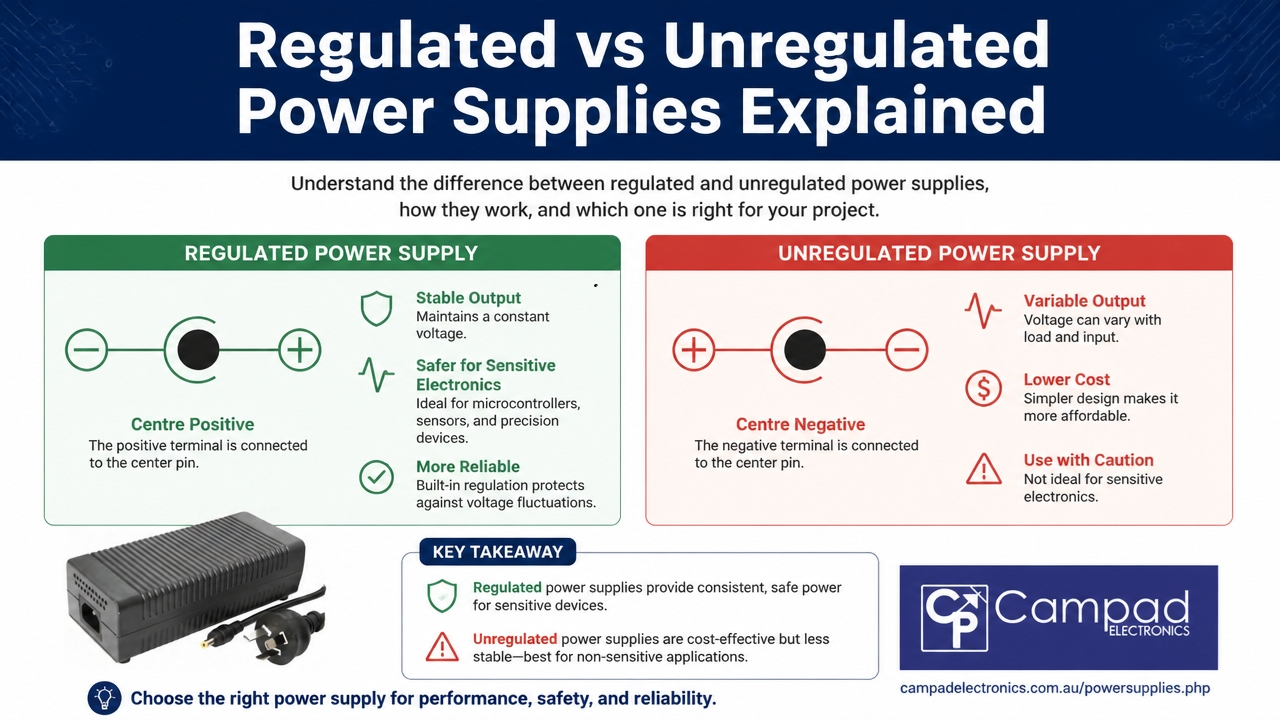
At Campad Electronics, a wide range of DC power supplies and power adapters is available and most of the switchmode units stocked are regulated. This article explains what that means, how unregulated supplies differ and why modern electronics depend on the stability that regulated power supplies provide.
What “Regulated” Means
A regulated power supply maintains a constant output voltage regardless of changes in the input voltage or the load placed upon it. Internally, a regulated supply uses a feedback circuit that continuously monitors the output voltage and adjusts the power conversion process to keep the voltage at a set level.
Example: For example, a regulated 12-volt supply will output very close to 12 volts whether the device drawing power pulls 0.1 amps or the full rated current of the supply. Even if the Australian mains voltage fluctuates between 220 volts and 250 volts, the output remains stable at 12 volts.
An unregulated power supply, by contrast, has no such feedback mechanism. The output voltage is determined by the transformer turns ratio and the raw rectified AC input. Under a light load, an unregulated supply may output a voltage significantly higher than its nominal rating. Under a heavy load, the voltage will sag or drop below the nominal rating. This voltage variation is inherent to the design.
Voltage Stability Differences
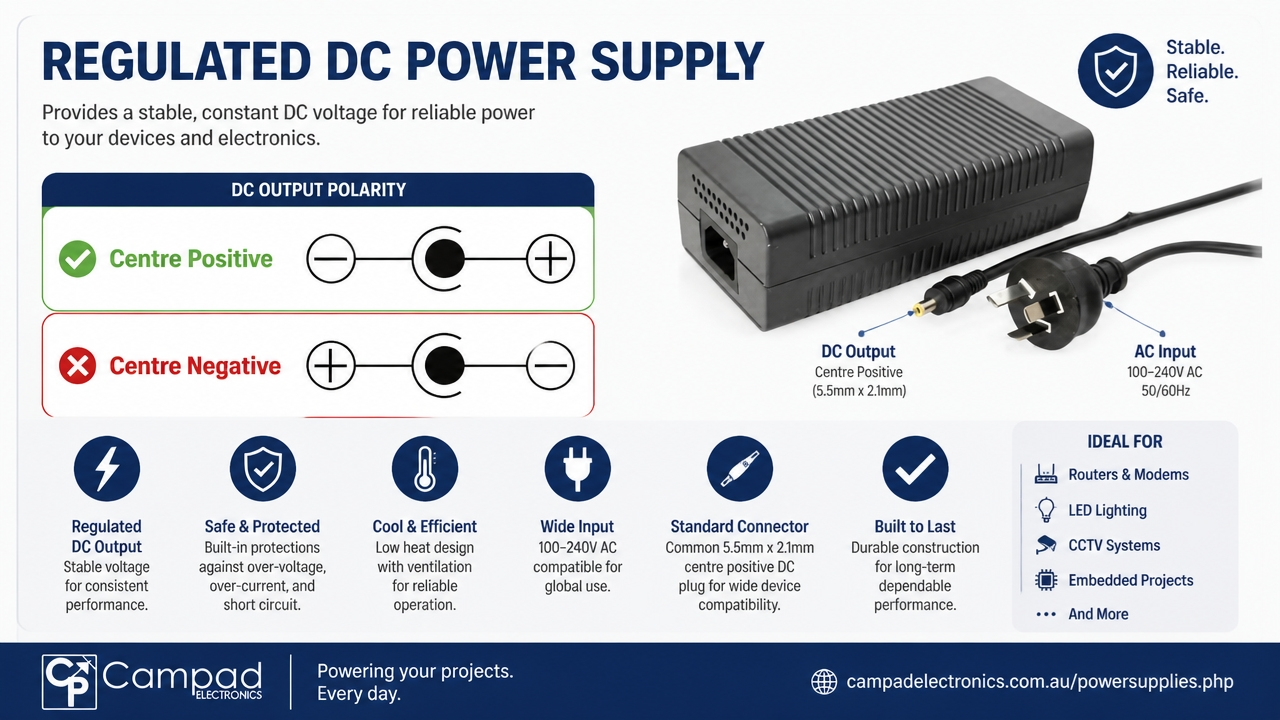
The difference between regulated and unregulated supplies is most clearly seen by measuring output voltage under varying conditions.
Unregulated Supply
-
→
At no load, output voltage may be 30–50% higher than the rated voltage
-
→
As load current increases, output voltage drops steadily
-
→
The output voltage rises and falls with fluctuations in the mains supply
-
→
Voltage ripple is often higher, particularly under load
Regulated Supply
-
✓
Output voltage stays within a tight tolerance, typically ±5% or better
-
✓
Voltage remains constant from zero load to full load
-
✓
Mains input variations of ±10% have little to no effect on the output
-
✓
Voltage ripple is typically low and well controlled
For most electronic circuits, this stability is not optional. A microcontroller rated for 5 volts can be damaged or malfunction if supplied with 7 volts. A motor driver expecting 24 volts may not operate correctly at 19 volts under load. Regulated supplies prevent these problems.
When Regulation Matters
The vast majority of modern electronic equipment requires a regulated power supply. Digital logic, microprocessors, wireless modules, sensors and precision analog circuits all depend on a stable supply voltage to function correctly and safely.
Voltage spikes from an unregulated supply can destroy semiconductor components. Voltage sags can cause erratic behaviour, resets, corrupted data and intermittent faults that are difficult to diagnose. The tighter the voltage tolerance of the equipment, the more critical regulated power becomes.
Where Unregulated Supplies Fit:
Warning: The no-load voltage can be dangerously high. If the load is disconnected, the output voltage may rise well above the equipment’s rated maximum.
Regulated Switchmode Supplies
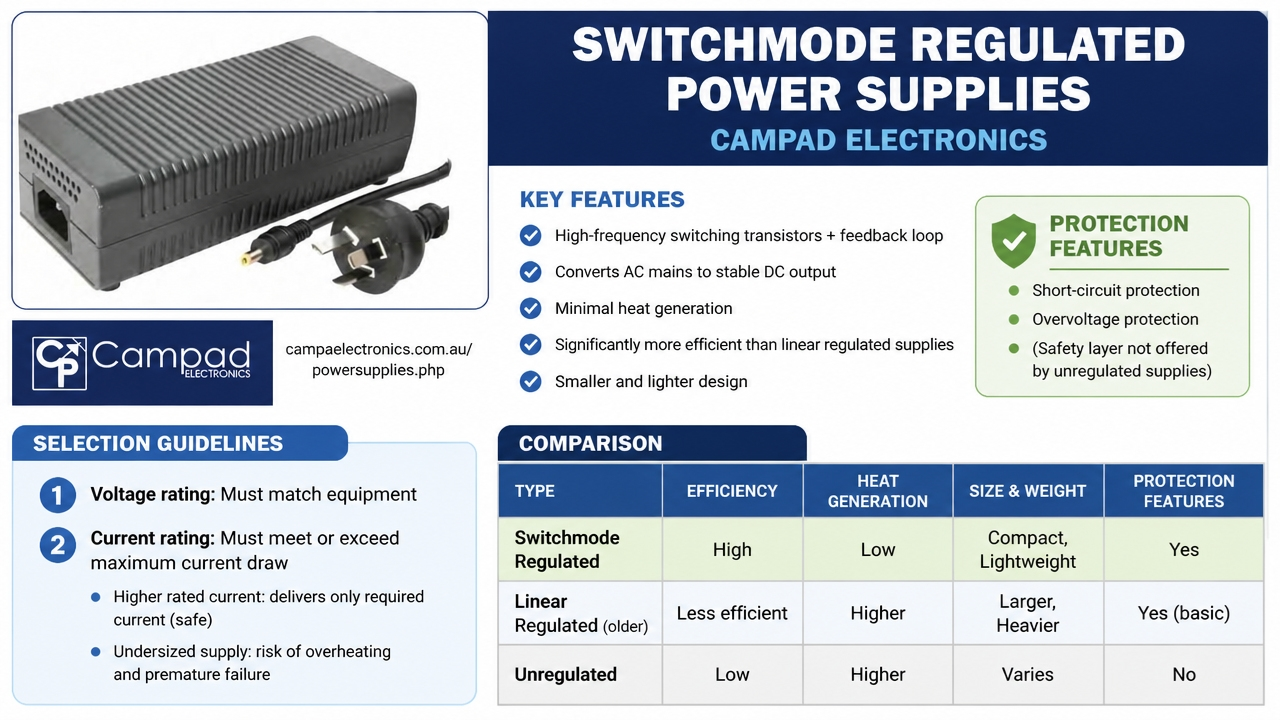
The switchmode power supplies commonly available from Campad Electronics are regulated designs. Using high-frequency switching transistors and a feedback loop, these supplies convert AC mains to a stable DC output while generating minimal heat.
They are significantly more efficient than older linear regulated supplies, making them smaller, lighter and more practical for a wide range of applications. They also typically include protection features such as short-circuit protection and overvoltage protection.
Selection Guide:
Match the voltage exactly. Choose a current rating that meets or exceeds the maximum current draw. A higher-rated supply is safe—it will only deliver the current the load draws.
Summary
Understanding the difference between regulated and unregulated power supplies comes down to one core principle: voltage stability.
Unregulated supplies vary their output with load and mains conditions, making them unsuitable for most modern electronics. Regulated supplies maintain a consistent output voltage, protect connected equipment from voltage spikes and sags and include important safety features.
Choose a regulated switchmode power supply with the correct voltage and adequate current rating and the equipment will operate as intended.
Technical FAQ
Q. Are unregulated supplies dangerous?
Unregulated supplies are not inherently dangerous when used correctly, but they present more risk to connected equipment than regulated supplies. The no-load output voltage of an unregulated supply can be significantly higher than the nominal voltage, which can damage or destroy electronic circuits. Unregulated supplies should only be used in applications where voltage variation is acceptable and where the designer has accounted for worst-case conditions. For any equipment containing microprocessors, memory or sensitive analog circuits, a regulated supply is the safe choice.
Q. Which type should I choose?
For any modern electronic device, a regulated power supply is the appropriate choice. Computers, routers, sensors, chargers and control systems all require stable DC voltage to operate reliably. An unregulated supply may be acceptable for simple resistive loads like incandescent lamps or heating elements, but these applications are relatively rare. When in doubt, choose a regulated supply. The performance, safety and peace of mind are well worth the small additional cost.
Q. What is the difference between a linear regulated supply and a switchmode regulated supply?
A linear regulated supply uses a transformer to step down AC voltage, then a series pass transistor to drop excess voltage, maintaining a constant output. It is simple and low-noise but inefficient, generating significant heat, especially at higher currents. A switchmode regulated supply uses high-frequency switching transistors and a feedback loop to convert AC to DC with minimal heat loss. It is smaller, lighter and more efficient, making it the preferred choice for most modern applications, though it may introduce high-frequency switching noise that sensitive analog circuits might need to filter.
Q. Can I use a regulated power supply to charge a battery?
Yes, but only if the regulated supply has current limiting or is specifically designed for battery charging. A standard regulated supply maintains a fixed voltage; if connected to a deeply discharged battery, it may attempt to deliver excessive current, potentially overheating the supply or damaging the battery. Use a regulated supply with adjustable current limiting or a dedicated battery charger. Unregulated supplies are sometimes used for simple lead-acid charging, but they require careful monitoring to avoid overcharging.
Q. Why does an unregulated supply have a higher no-load voltage?
An unregulated supply consists of a transformer, rectifier and filter capacitor. The transformer output is rated at a nominal voltage under full load. With no load, the filter capacitor charges to the peak value of the rectified AC waveform, which is about 1.414 times the RMS voltage. Also, transformer regulation losses are absent at no load, so the voltage rises well above the nominal rating. As load increases, the capacitor discharges more between cycles and the transformer voltage sags, causing the output to drop.
Q. Will a regulated supply with a higher current rating damage my device?
No. A regulated supply is a voltage source; it delivers only the current that the load draws, not its maximum rated current. For example, a 5-volt, 10-amp regulated supply connected to a circuit drawing 0.5 amps will deliver only 0.5 amps. The supply’s rating is the maximum it can safely provide. Using a higher-rated supply is generally safe and can even be beneficial, as it runs cooler. Ensure the supply’s voltage matches the device exactly.
Q. What happens if I overload a regulated power supply?
A regulated supply with overload protection will either shut down, fold back (reduce output voltage) or limit current to protect itself. If the supply lacks protection, exceeding its rated current can cause overheating, component failure or a fire risk. Always check the supply’s specifications for short-circuit and overcurrent protection features. Campad Electronics’ regulated switchmode supplies typically include these protections, but it is wise to verify before use.
Q. How much voltage ripple is acceptable in a regulated supply?
Ripple is the residual AC fluctuation on the DC output. For most digital circuits, ripple below 50 millivolts peak-to-peak is acceptable. Precision analog circuits, audio equipment or measurement devices may require ripple below 5 millivolts. Switchmode regulated supplies often have ripple in the range of 10–50 millivolts, which is fine for most electronics. If your application is highly sensitive, consider adding an additional linear post-regulator or a low-pass LC filter at the output.
Q. Are unregulated supplies ever more efficient than regulated ones?
Under full load, an unregulated supply can be slightly more efficient because it lacks the feedback and control circuitry that consumes a small amount of power. However, this difference is small in practice. Regulated switchmode supplies achieve efficiency above 85–90%, whereas unregulated linear supplies typically operate at 50–70% efficiency. At light loads, unregulated supplies become less efficient due to fixed transformer losses, while regulated switchmode supplies maintain efficiency. For most applications, the regulated supply is the more energy-efficient choice overall.
Q. Can I convert an unregulated supply to a regulated one?
Yes, by adding a voltage regulator circuit after the unregulated output. For example, a linear regulator IC (such as a 7812 for 12V) or a DC-DC buck converter can be inserted between the unregulated output and the load. The unregulated supply must have a minimum input voltage above the desired regulated output, even at full load and low mains. This is a common DIY approach but is usually less efficient and more expensive than simply buying a regulated supply.
Q. Why do some devices specifically require an unregulated supply?
Some devices, such as certain motors, solenoids or heating elements, are designed to tolerate voltage variation and may even rely on the higher no-load voltage to energize quickly. In rare cases, audio amplifiers use unregulated supplies because the raw supply rails can collapse under heavy bass loads, allowing the amplifier to deliver more instantaneous power. However, this is a niche design choice. For any device with a specified voltage tolerance, a regulated supply is always safer.
Q. What is the typical voltage tolerance of a regulated supply?
Most regulated switchmode supplies maintain output voltage within ±2% to ±5% of the nominal rating, from zero load to full load and across input mains variations of ±10%. High-quality laboratory supplies may achieve ±0.1% or better. Always refer to the manufacturer’s datasheet for the exact tolerance. For unregulated supplies, tolerance is not specified in the same way, as output varies continuously with load and input conditions.